

My experience – by Thomas Müller
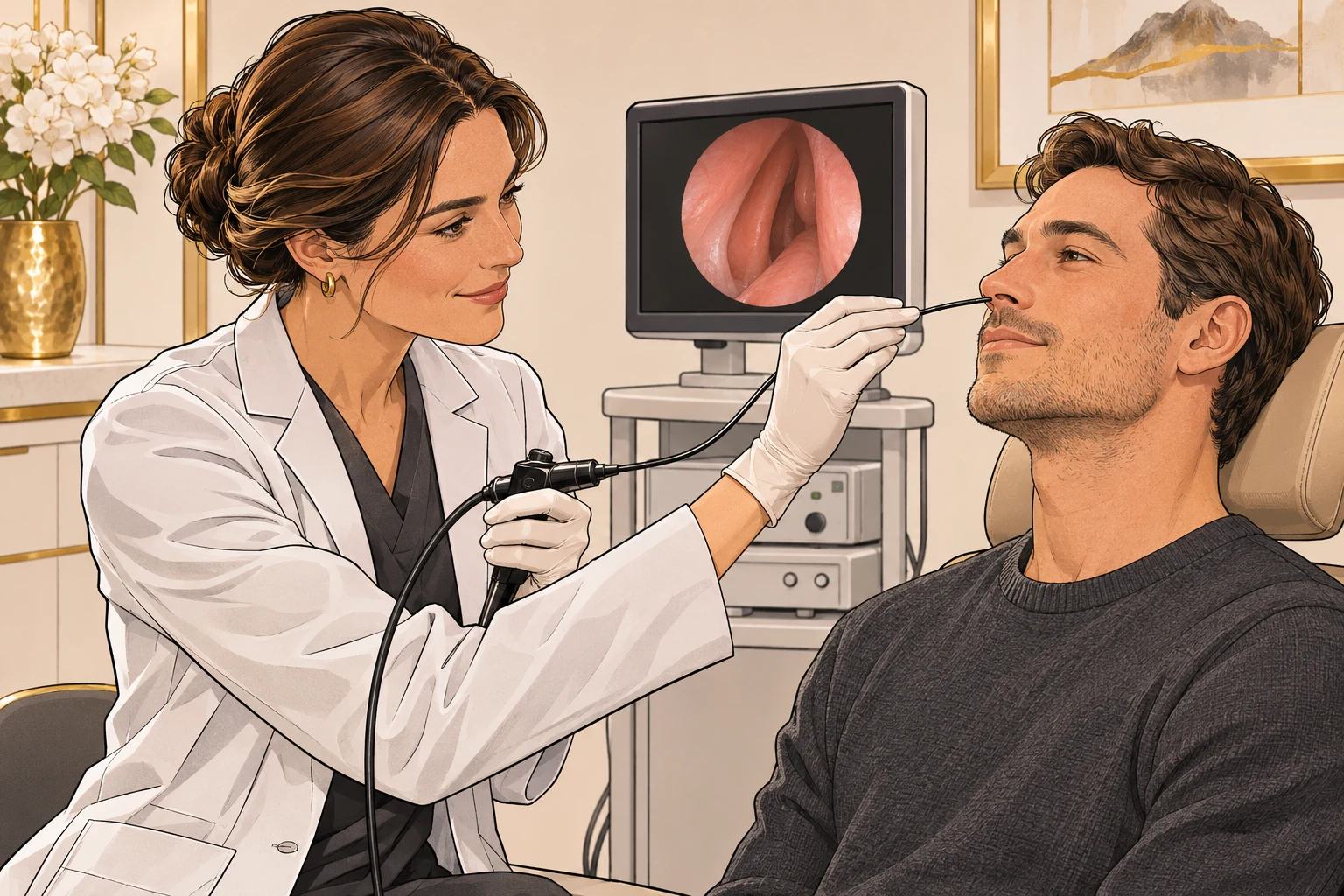
What actually happens at an ENT appointment? It helps me to understand the examination. Video endoscopy gives me a visual insight into the upper airways. This makes it easier to understand what the doctor is assessing and which abnormalities might be relevant to my symptoms.
For me, the shared discussion is central: What do we see? What could it explain? And which solution fits my findings and my everyday life?
What is examined?
Depending on the symptoms, an ENT examination may look at the nasal septum, the nasal and throat regions, the tonsils, soft palate, tongue base and epiglottis. The treating professional decides which areas to examine and how.
A thin, flexible endoscope is carefully passed through a nostril. A camera can transmit the images to a screen. The images can be discussed together during or after the examination. Not every finding is assessed by endoscopy alone.
Understand first. Then discuss the options.
My wish is to look at appropriate non-invasive options first, before discussing surgery. Together with the doctor, I want to understand the alternatives and their advantages and disadvantages for me.
Which treatment is medically appropriate, and in what order it takes place, depends on the diagnosis and individual findings. Surgery is therefore neither automatically necessary nor ruled out in principle.
An insight – not a complete sleep assessment
The examination can reveal anatomical narrowing and other abnormalities. However, an examination while awake does not fully show what happens during sleep. Free nasal breathing does not rule out sleep apnoea. If it is suspected, additional examinations such as a respiratory sleep study or a sleep laboratory assessment may be needed.
Your next step
Write down your symptoms and questions. Discuss with your GP or the first point of contact required by your insurance model whether an ENT assessment would be useful. You can find ENT providers on our Swiss map.
This article reflects my personal perspective. It does not replace individual medical advice.