

Why measure at all?
Snoring alone does not tell you whether breathing stops during the night. A respiratory sleep study records physical signals during sleep. It helps the doctor assess suspected sleep apnoea in more detail.
What matters to me is that you understand the next step: a screening test provides guidance. Monitoring provides additional information. Only the medical assessment puts everything into context.
1. Start with the risk screening test
The Lunge Zürich sleep apnoea risk screening test asks about signs and risk factors. The result may indicate that further assessment would be useful. It is not a diagnosis and does not determine on its own which examination you need.
2. Record the result in the BBT
Bring your result to the BBT snoring consultation. During the BBT, we discuss the risk screening test and record the result alongside your symptoms. You can then take this information to your appointment with your GP.
Together, you clarify whether overnight monitoring would be useful and which examination suits your situation.
3. Monitor one night at home
In a conventional respiratory polygraphy study, a portable device measures signals including airflow, breathing movements, oxygen saturation and pulse. Depending on the device, body position and snoring sounds may also be recorded. After being shown how to use it, you fit the sensors according to the instructions and sleep in your usual surroundings.
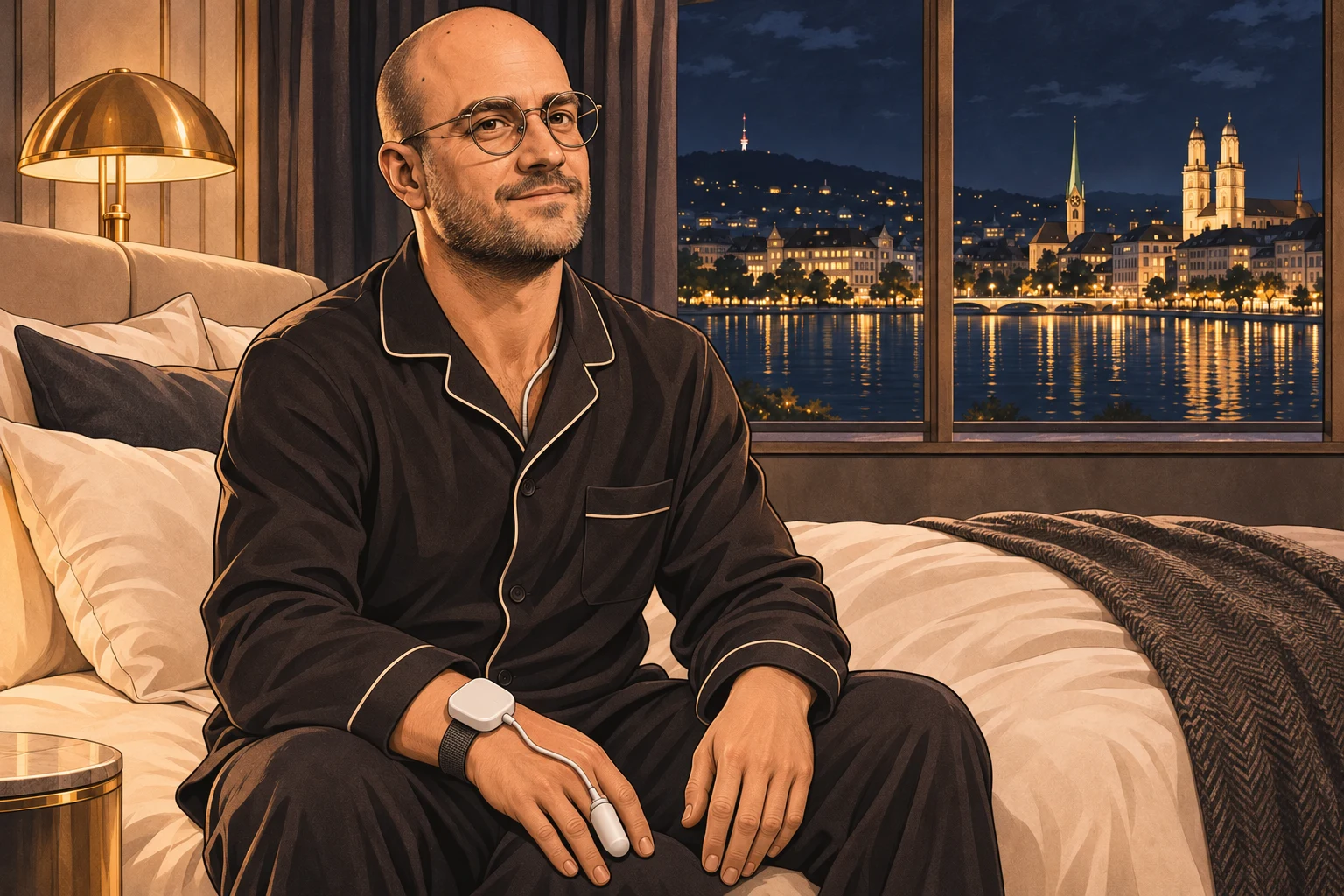
The symbolic illustration shows a different type of home sleep test: a device based on the WatchPAT principle with a wrist unit and finger sensor, supplemented by a chest sensor depending on the model. Among other signals, it uses peripheral arterial tone (PAT) and should not be equated with conventional airflow-based respiratory polygraphy. The supervising service determines which device is suitable.
4. Discuss the findings and next steps
The recorded data are assessed by a doctor. You discuss whether a sleep-related breathing disorder is present and which further steps are appropriate. If the results are unclear or suspicion remains, an examination in a sleep laboratory may be necessary.
Good to know
Risk screening and the BBT do not replace a medical diagnosis. An unremarkable home test does not rule out sleep apnoea in every situation either. Discuss observed pauses in breathing or marked daytime sleepiness with a doctor. Dilli does not replace this assessment or any necessary sleep apnoea treatment.