 BREATHE CIRCLEAll articlesBuy Dilli
1. What happens to our tongue when we sleep?
Imagine lying comfortably in bed. You feel tired, close your eyes and drift off. Your body begins to relax. Your arms grow heavy and your legs are still. The muscles in your mouth and throat relax too. All of this is normal.
In some people, something else happens. The base of the tongue and the soft tissue in the throat can fall back and narrow the airway. Suddenly, there is less room for air to pass through.
When air flows through this narrower space, the tissue can start to vibrate. That is the sound we hear as snoring. In obstructive sleep apnoea, the upper airway can even close completely for short periods.
The body repeatedly has to work against the blockage. Sleep is disrupted, often without us realising it.
When the tongue narrows the airway
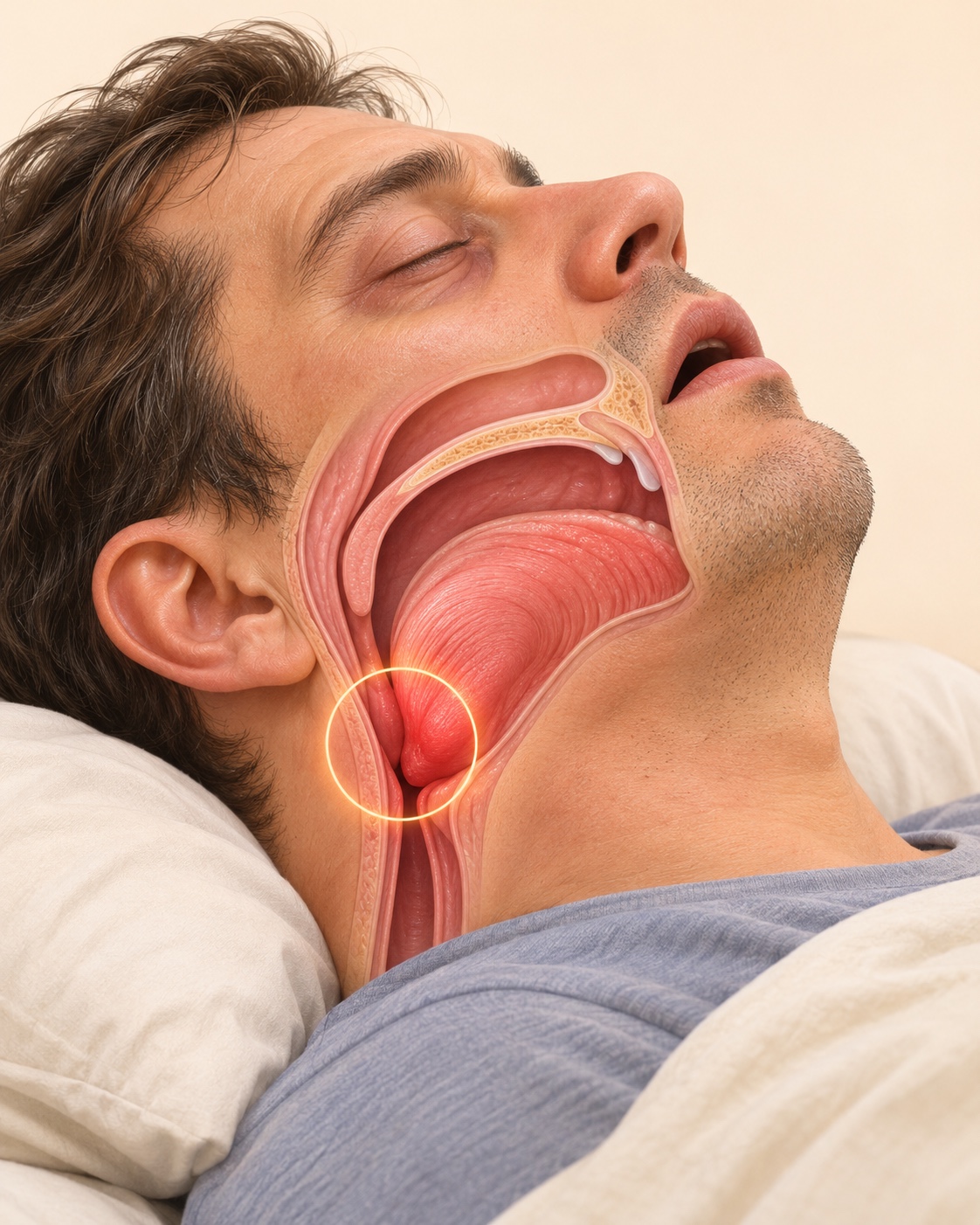
Look at the gold circle. It shows how the base of the tongue can narrow the passage that air travels through in the throat.
Snoring can have several causes, and sleep apnoea can involve other parts of the airway as well as the tongue. That brings us to an interesting question.
2. If the tongue is a muscle, can we train it?
More precisely, the tongue is made up of several muscles that work closely together. They help us speak, chew, swallow and move things around in the mouth. These muscles can be trained.
Think about a weak knee. A brace can give it support. At the same time, targeted exercise can help improve how well it works and how stable it feels.
Could we apply that idea to the muscles of the upper airway? That is where the didgeridoo comes in.
3. What does playing the didgeridoo ask of the tongue?
You may know the didgeridoo as a traditional Australian wind instrument. It produces a distinctive vibrating sound.
To make that sound, the lips, tongue and other muscles of the mouth and throat have to work together. Playing puts both our breathing and those muscles to work.
Regular practice aims to improve the way these muscles function. The hope is that the upper airway might stay more stable during sleep and be less likely to collapse.
When the tongue muscles are working
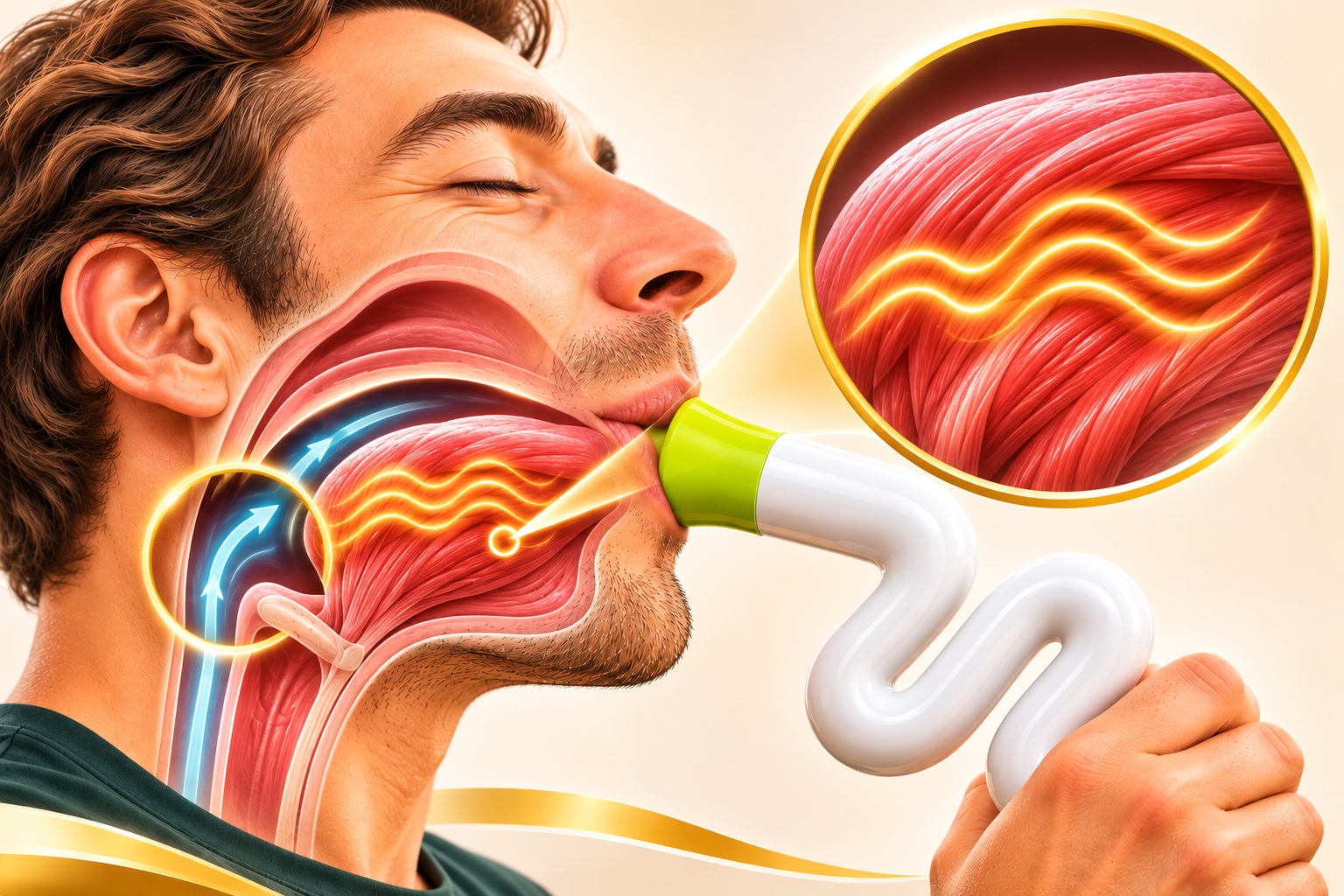
Can you see the gold waves on the tongue? They illustrate muscle activity during practice. The gold circle at the throat shows what we are interested in: giving air as clear a passage as possible.
The image is simplified. Playing does not automatically keep the throat open permanently. Researchers are interested in the possible effect of regular practice on how the muscles work.
4. Can playing the didgeridoo really help with snoring and sleep apnoea?
Researchers have explored this idea. A small Swiss study of 25 adults, published in the British Medical Journal in 2006, investigated regular didgeridoo practice in people with snoring and moderate obstructive sleep apnoea.
After four months, the training group showed improvements relative to the control group in daytime sleepiness and in the apnoea–hypopnoea index, a measure of sleep apnoea severity.
This small study suggests that some people may benefit. It does not show that playing the didgeridoo cures all sleep apnoea or guarantee results for everyone using any of today's training systems. That possibility of a benefit is what interests me.
5. Could training complement the support we already use?
There are several ways to treat sleep apnoea. A CPAP mask delivers air under pressure to hold the airway open during sleep. A mandibular advancement device brings the lower jaw forward and can create more space in the throat. These treatments can be necessary and highly effective.
Could we also try to strengthen the muscles themselves? Alongside keeping the airway open at night, could we actively work on how those muscles function in the long term? That is the idea I keep coming back to.
I would like targeted training to help people improve their symptoms over time. After a fresh medical assessment, some people may eventually be able to manage with less treatment support.
There is no guarantee of that outcome. Never stop prescribed CPAP treatment or stop using a mandibular advancement device on the basis of training alone.
6. The Silent Sleep approach
Today I spoke with Aaron from Silent Sleep about these ideas. Silent Sleep offers a medical didgeridoo training system designed for targeted practice of the muscles of the mouth and throat.
What interests me is how this approach lets us look at what our bodies can do alongside the devices that support them. These are the possibilities we want more people to learn about through Breathe Circle.
Sometimes improvement starts with understanding what is happening in our bodies. The tongue helps us taste and speak, and it is an important part of our muscular system. Perhaps it deserves a little more attention.
👃 Curious about how the training works?
Take a look at Silent Sleep's medical didgeridoo and learn how the training is structured.
I'd love to hear what you think. Did you know you can train the muscles of the tongue and throat?
Warm wishes · Thomas Müller · Breathe Circle
Breathe freely. Live better.
Medical information
Both images are illustrations. Didgeridoo training can be a complementary activity. It cannot replace medical assessment or necessary sleep apnoea treatment. A doctor must assess whether and how your treatment can be adjusted.